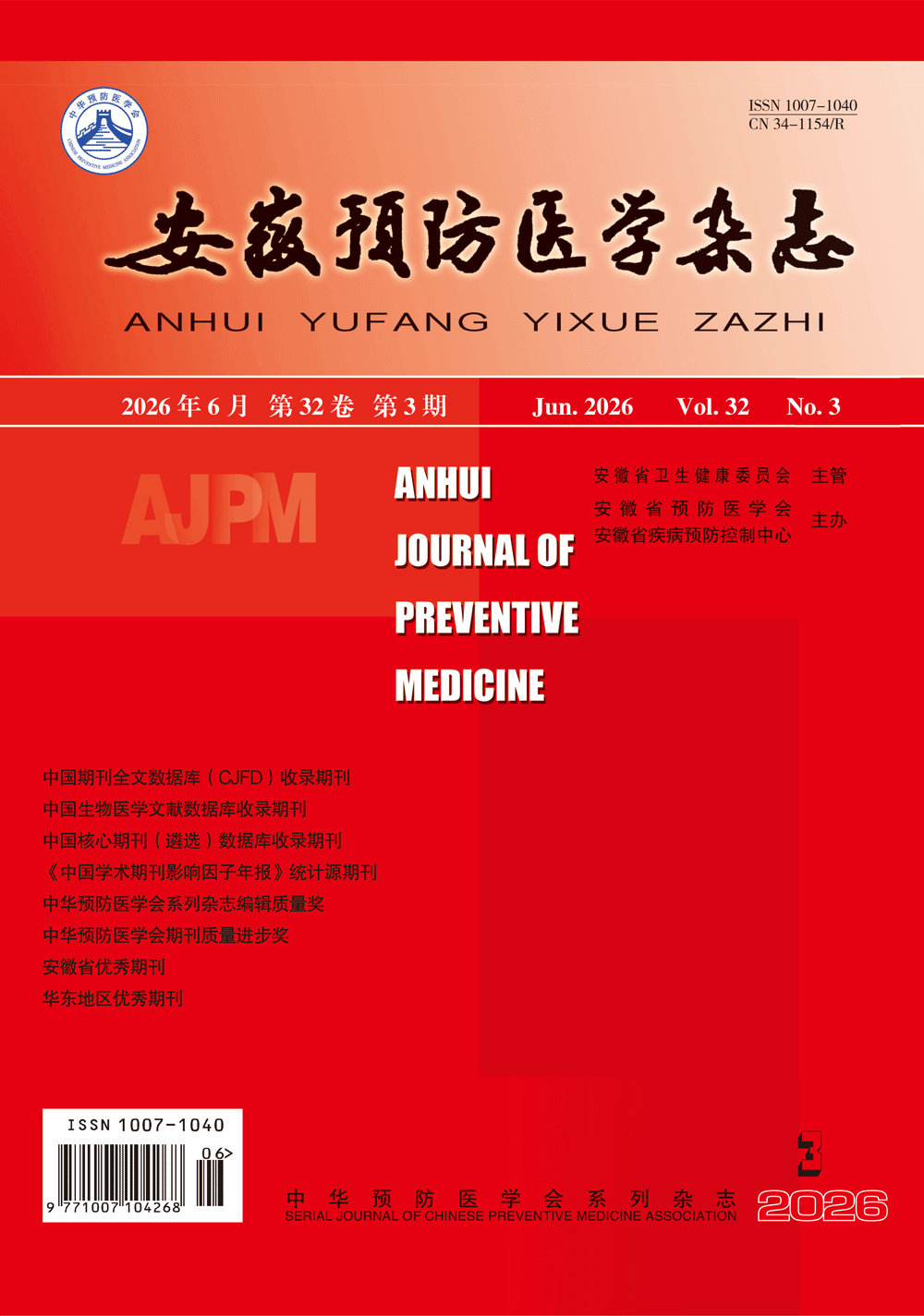
The Anhui Journal of Preventive Medicine (ISSN 1007-1040,
CN 34-1154/R) is an academic journal in the field of preventive medicine,
supervised by Health Commission of Anhui Province and sponsored by Anhui
Preventive Medicine Association and Anhui Provincial Center for Disease Control
and Prevention. Founded in 1995, it joined the series of journals of the Serial
Journal of Chinese Preventive Medicine Association in 2015. It is now a source
for the Annual Report for Chinese Academic Journal Impact Factors and
has been included in important databases such as the China Core Journals Database (Selection), China Journal Full-text Database,
and China Biology Medicine disc. The journal has been awarded a number
of honors, including the Journal Quality Improvement Award of the Chinese
Preventive Medicine Association, Outstanding Journal in East China Region and
Outstanding Journal of Anhui Province..
1 Scope and Sections
Anhui Journal of Preventive Medicine is dedicated to publishing the latest advances and research
findings in public health and preventive medicine in China. It covers a range
of topics through sections such as Original Articles, Disease Control,
Investigations, Public Health Management, Health Supervision and Monitoring,
Laboratory Techniques and Methods, Maternal and Child Health, Health Education
and Promotion, and Reviews.
2 Manuscript Requirement
2.1 General Specifications
The Manuscripts should demonstrate rigorous scientific validity and
logical structure, with clear arguments, reliable data, accurate results,
concise language, clear organization, and standardized formatting. Submissions
must be made through the online system and accompanied by an introduction
letter and an exclusive publication license agreement (template downloadable
from the journal website), certifying that the content is authentic, free of
academic misconduct, and without authorship disputes.
2.2 Word Count
The total word count should generally be no less than 6,000 words.
2.3 Title
The title should be concise and accurately reflect the subject of
the article. It should generally not exceed 20 characters and avoid
abbreviations or punctuation marks.
2.4 Authors and Affiliations
The authors and affiliations should be attributed to individuals
who participated in the topic selection and design, contributed to the specific
work, and are responsible for the research outcomes. The full names,
institutional affiliations, provinces/municipalities, and postal codes of all
authors must be listed. The full names of the first author and corresponding
author (department) should be specified. Author names should be placed below
the Chinese and English titles, with commas separating multiple authors. For
authors from different institutions, Arabic numerals should be added to the
upper right of each name, followed by their respective institutions in
numerical order, separated by commas. The first author's profile (name, birth
year, gender, title, degree, research focus, or primary work) and the
corresponding author's name, phone number, and e-mail address should be
included in the first-page footer. All authors and institutions must have
corresponding English translations, ensuring consistency between Chinese and
English. For funded projects, the project name and number must be specified,
with multiple grants listed in order of funding level, separated by semicolons.
Scanned copies of grant certificates should be attached when submitting the
manuscript.
2.5 Abstract and Keywords
The abstract should be self-explanatory and independent, enabling
readers to easily access essential information. It should highlight the
innovative aspects of the research and the author's unique perspectives,
without paragraph breaks. Typically written in the third person, it should
avoid commentary or explanations. For new terms or those without verified
Chinese translations, the original term may be used or the original term in
parentheses. The abstract should be approximately 400 words. The paper must
include 3 to 8 keywords.
For original articles, a structured abstract is required,
including Objective, Methods, Results, and Conclusion. Each section is titled
in small 5-point bold font with 1-character spacing, while the abstract content
is in small 5-point Song font. English titles for each section should be
adjusted to singular or plural forms as appropriate. For review articles, the
abstract may adopt an indicative or report-style format, including the primary
objective, data sources, data selection, data extraction, data synthesis, and
conclusions. Refer to the Compilation rules of document abstracts (GB/T
6447–2025) for
specific guidelines.
2.6 Technical Terminology
The terminology shall be based on the definitions approved by the
China National Committee for Terminology in Science and Technology. If
abbreviations are used, they shall be annotated in parentheses after the full
Chinese name upon first occurrence in the text. Foreign terms without Chinese
equivalents shall be used in their original form.
2.7 Figures and Tables
Figures and tables should avoid duplicating content between
figures or tables. They should be sequentially numbered according to their
order in the main text. Each figure or table must have a concise and accurate
Chinese and English title. Tables should be kept simple, typically using three
horizontal lines without vertical ones. Coordinate graphs must clearly label
both vertical and horizontal axes along with captions. All images must be
submitted to the submission system in JPG or TIF format (300 dpi or higher) for
typesetting purposes, in addition to being presented in the text. For images
generated from Excel data, the original data files must also be provided to
allow the editorial team to recreate the graphics as needed to meet publication
requirements.
2.8 Measurement Units
Quantities and units—General principles (GB/T 3101–1993) shall be followed.
2.9 Numerals
Refer to the General rules for writing numerals in public texts (GB/T 15835–2011). For the Gregorian calendar, use Arabic numerals for
centuries, years, months, days, hours, and for counting or measurement
purposes. When the decimal point has more than three digits, group the digits
into clusters of three, with a 1/4 Chinese character space between clusters.
The number of significant digits in the full text should be consistent, and
regardless of the number of digits, statistical data must retain three
significant digits.
2.10 Statistical Symbols
In accordance with the relevant provisions of Statistics-Vocabulary
and symbols (GB/T 3358–2009), all symbols shall be in italics. Other norms for commonly
used statistical symbols in medical and health science journals are as follows:
(1) The arithmetic mean of a sample is denoted by lowercase English letters or
mean (the median is denoted by M or median in English); (2) Standard
deviation is denoted by lowercase English letters s or uppercase SD (limited to English literature); (3) Standard error is denoted by lowercase
English letters Sx or uppercase SE (limited to English
literature); (4) The student's t test is denoted by lowercase English
letters t; (5) The F-test is denoted by uppercase English letters F; (6) The chi-square test is denoted by lowercase Greek letters χ2;
(7) The correlation coefficient is denoted by lowercase English letters r;
(8) The degree of freedom is denoted by lowercase Greek letters ν or df (limited to English literature); (9) Probability is denoted by uppercase
English letters P (the specific test value, such as t-value, χ2-value, q-value, etc., should be provided before the P-value); (10) The number
of samples is denoted by n; (11) The confidence interval is denoted by
uppercase English letters CI.
2.11 Acknowledgments
The acknowledgments section should follow the main text.
Acknowledgments should include: (1) institutions and individuals who funded the
research, as well as collaborating organizations; (2) organizations and
individuals who assisted in completing the research or provided logistical
support; (3) those who contributed to the diagnosis and offered valuable
suggestions; (4) owners of materials, images, literature, research ideas, or
concepts that were reprinted or cited; (5) contributors who could not be named
as authors but provided technical assistance or financial/material support,
with the nature of their contribution clearly stated; (6) other individuals
deserving acknowledgment.
2.12 Conflicts of interest
The author shall publicly declare any existing or potential
conflicts of interest related to the study and be responsible for the
authenticity of the declared content.
2.13 Author Contribution Statement
All authors must declare their contributions to the paper.
2.14 References
The documentation standards shall comply with the Information
and documentation—Rules for bibliographic references and citations to
information resources (GB/T 7714–2025). All citations must be sourced from
original works (excluding translations, abstracts, reprints, or internal
materials), numbered in the order they appear in the text, and marked with
square brackets in the upper right corner of the citation. Please verify that
the reference sequence in the main text is coherent, and that the reference
numbers, authors, and their corresponding numbers in the subsequent references
are consistent.
2.15 Statement of Artificial Intelligence Generated Content
Authors submitting manuscripts to Anhui Preventive Medicine
Journal must strictly limit the use of generative AI tools during the
writing process. (1) Direct generation of key components such as the main
framework, core arguments, and research conclusions using generative AI tools
is prohibited. (2) Rewriting others' work or piecing together multiple
documents to circumvent detection is prohibited. (3) Concealing or making false
statements about the use of generative AI tools is prohibited. (4) Using
generative AI tools to forge, alter, or fabricate documents, data, charts, or
other content is prohibited.
3 Editorial Policies
3.1 Submission Protocol
Anhui Preventive Medicine Journal accepts only online submissions (submission website:
http://www.ahyfyxzz.cn). Authors may log in to the journal's website using
their registered username and password to track the progress of manuscript
processing. The editorial office of Anhui Preventive Medicine Journal does not entrust any third-party institutions to solicit manuscripts. Please be
cautious of counterfeit websites and verify their authenticity.
3.2 Copyright & Licensing
By submission, authors grant Anhui Preventive Medicine Journal exclusive rights for print/digital publication, translation, database indexing,
and derivative works. Post-acceptance modifications require editorial approval.
After the manuscript is published, the author will be presented with two copies
of the current issue of the magazine. No separate remuneration for open-access
distribution. Upon acceptance of a manuscript, it shall be deemed as consent to
the publication of the manuscript by Anhui Preventive Medicine Journal in electronic journals, CDs, or other formats, and no additional remuneration
will be provided. Authors who disagree may submit their manuscripts to other
journals or declare their disagreement upon submission, and the journal will
handle the matter appropriately.
4. Contact Information
Editorial Office
Address: No.12560 Fanhua Avenue, Jingkai District, Hefei 230601,
Anhui, China
Tel: +86-551-63674959
Email: ahyfyxzz@ahcdc.com.cn, ahyfyxzz@126.com
Pubdate: 2026-01-08
Viewed:
1173